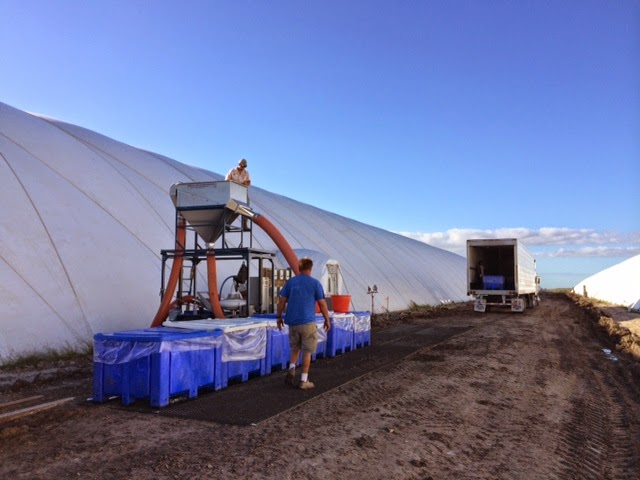
I often do posts on my blog for cathartic reasons, sometimes to address something that really bothers me, sometimes to share information that I think others might appreciate, and also to talk about my company and what we are trying to do to help make a difference in the world.
The following is an interview I recently did with my partner and friend of over 20 years, John Aquilino. The article has been posted on the web site of our company under "NEWS".
I thought it might be worth running again so I am posting on my blog.
Interview with GBT
Chairman, David K. Wills
John Aquilino: David,
you and I have been partners for the past 20 years. Some 15 years ago, we sat down together to
decide what path our company should follow.
Since the beginning we focused on trying to do things better for those
in need of medical research, better in terms of how farmers raised their
livestock, how corporations sourced their seafood, and better for the earth in
general. You had been literally around
the world showing Red Lobster and other major corporations how to avoid
suppliers who overfished Ocean stocks, polluted water with their aquaculture
practices, destroyed coral reefs, exploited their workers and more.
David Wills: Those were the days! In hindsight, I think we were modern-day
Cassandra’s. We told the truth and our
words floated past deaf ears. That’s
when we decided to take our own advice and put our words into action for our
own company instead of advising others.
That’s also the time when we were asked to do an analysis of millions of
dollars in Congressional funding that over the past decade failed to produce a
world-class, competitive shrimp aquaculture industry for the U.S. So our experience and the convergence of fate
set our path for us.
JA: The path to Texas
took some mighty big turns didn’t it?
DW: You can say that
again. In Mississippi, we saw the fruit
of the research those federal dollars supported but we also saw that research
is not the same as entrepreneurship.
Building an industry is not what academia is all about. Then, we went to South Africa and proved we
could grow commercial quantities of outstanding shrimp. We also learned the flaws in that early
system design. From there it was back
home to the United States to develop the system we are using now.
JA: David, you first
arrived in Texas in February 2011. It’s
three years and eight months later and I think we both agree it’s time to tell
friends, investors and folks across Texas the state of Global Blue Technologies
today.
DKW: All things
considered, we’ve made incredible progress.
JA: How so?
DKW: We just
harvested 13.6 metric tons of shrimp weighing between 30-45 grams from three
ponds with 85 to 90 percent survival.
The average harvest from open pond farms throughout the world yields, at
best, two metric tons of 16-20 gram shrimp per hectare with 60 percent
survival. A handful of super intensive
farms say they can grow 20 metric tons of the same size shrimp with the same
average survival. Maybe. If they can, I say good for them.


Let me put the importance of the data collected from our
three-pond harvest in perspective. A
hectare equals 2.47 acres. The three
ponds we harvested barely total 1.18 acres combined. The average open-pond farm anywhere in the
world grows 4409.24 pounds of shrimp per acre.
Our harvest was 25,409 pounds per acre, almost six times that of the
average open-pond farm.
JA: That’s
impressive!
DKW: True. But it’s only a fraction of what we can do
once all systems are running at full capacity.
Those numbers are from ponds stocked at less than half density.
JA: Why is that?
DKW: GBT-Cameron, our
U.S. flagship farm, is a little less than a year behind schedule due to a
number of factors I will explain later.
For that reason our initial harvests are the aquaculture equivalent of a
“test flight” of a new aircraft or “shakedown cruise” of a Navy warship. No one, including our own staff, has ever
worked in a system like ours so the data from each pond we harvest helps
demonstrate the merits of our projections.
It also helps establish benchmarks by which we can tweak the system to
enhance efficiency.
When we say our harvests of minimally stocked ponds yield
six times the average biomass with double the survival, no one in the industry
believes us. Those figures just seem
incredible if not impossible. To us they
are just the beginning of what we can do.
If we average only 10,000 pounds for each of the eight ponds
stocked at less than half their stocking density, then we should pull 80,000
pounds of shrimp from all eight ponds per module after those first harvests.
Once stocked to full capacity, those ponds, we believe, will
yield double, even triple that biomass per pond per harvest. With partial harvests it is conceivable that
we can get four or five times the production of that first harvest. In the future we will hit benchmarks of 20,000
to 30,000 to 50,000 pounds of shrimp per pond.
So each eight-pond module could produce from 160,000 to 400,000 pounds
of shrimp per module per harvest.
With one production footprint of four eight-pond production modules
and 2.5 harvests per pond per year... well, you do the math. Don’t forget to multiply by $10 a pound for a
conservative dollar figure.
JA: You are talking
serious numbers of shrimp!
DKW: We would be
hitting those numbers today if we did not encounter the delays I mentioned
earlier.
JA: Will you
elaborate on those delays and their effect on the facility?
DKW: Without them, we
would have gathered the data we are collecting now on growth, stocking density,
and more some six to eight months ago. Without that nearly year delay, today we would
be well into full-density commercial production and have a strong income stream
flowing. Our investors would see a
decent return before the end of the year.
Unfortunately that is not going to happen until 2015.
The first delay was from structural/construction issues both
in terms of quality of construction and failure to meet promised
deadlines. The combination quite
literally set us back by the better part of a year. We expected to have the ponds for the first
module covered by October 2013.
That second factor was the worst winter in Rockport, Texas history. If our pond shelters were delivered and
constructed on time, the weather would not have been a factor in pushing us so
far behind schedule. But delivery wasn’t
until December 2013, right in the middle of winter. The poor quality of construction compounded
the delay causing us to not take possession of our production facility and
start to prepare the ponds for stocking because of repeated and unsuccessful
attempts to repair the poor construction until April 2014.
We now realize we erred in not constructing our bio-filter
before our production module. The
frustration caused by the structural issues distracted us from the fact that
building the bio-filter first would have given us time to culture our biofloc in
quantities to handle greater initial stocking densities.
On a personal level, the death of my wife, Lori, after her
heroic struggle against the most lethal form of breast cancer – Triple Negative
Breast Cancer – and the four-year, 24/7effort to find a course of treatment to
save her life sapped my focus, my emotions, and every ounce of my energy. She was my life. Toward her end, daily activities of the farm
receded deep into a fog of utter sadness and loss. Luckily we’ve been very successful putting
together a team of incredibly wonderful individuals to run the farm while I
tried vainly to save Lori’s life.
I’m not looking for sympathy. I’m just letting everyone know where I was
emotionally during that time.
JA: What, in your
opinion, is the status of the company now?
DKW: We are in a
very, very good place. We know our
system works. We grow far larger
quantities of bigger, better tasting shrimp in less time with a smaller
environmental footprint than any other system.
Let me revisit my reference to our putting together a quality
team.
The Copano Bay facility as well as GBT’s international
production oversight is in the more than capable hands of Eduardo Figueras. Eduardo is recognized throughout the shrimp
aquaculture industry worldwide as the co-founder of the “Blue Revolution” for
his work to convince the industry that broodstock and PLs (post larvae) need
not be sourced from the wild. He proved the
science of genetics unlocked the way to raise both disease-free in hatcheries.

We’ve tapped decades of aquaculture experience when we hired
John Harvin and his son, Nick. Nick
Harvin is in charge of the daily production operations of the farm. Nick literally grew up on shrimp farms as he
followed his father’s career managing farms throughout Latin America.
Nick Harvin is typical of the young generation we put in
place to take GBT into the future.
Another talented young man on our team is my son, Stephen White. Stephen is the company’s COO and oversees all
purchasing, contracts, and budget compliance.
I could and probably should name everyone on our incredible
staff, from the young scientists to the workers upon whom we rely to keep the
farm in peak condition. But I will leave
it at Eduardo, Nick and Stephen. Rest
assured the future of GBT is in good hands.
If the mention of my son or of the fact that
we hired a father and son pair, the Harvin’s, gives anyone pause, let me relate
a conversation I had recently with an executive of a Fortune 500 company
trained at the Harvard Business School.
In a very patronizing tone, he cautioned me against hiring “friends and
family.” Very unwise he said. I looked at him and said, “so let me get this
straight. You think it’s better to hire strangers
and enemies?”
GBT is not only a team.
It is a family. That’s how we
treat each other. That’s how we treat
our investors. That’s how we treat
everyone who responds in kind with truth, integrity and respect.
I want to point out that we consider our investors a special
part of the GBT family. To the man and
woman, they are real people, not venture capitalists or investment bankers or
Wall Street types seeking a quick hit or a way to leverage ownership then sell
the company profiting only themselves and the investors be damned. A sizeable number of GBT investors are real
dirt farmers who understand the time and effort it takes to grow a crop or
raise livestock, concepts quite alien to the New York Finance world. GBT is, after all, a farm.
I want to give special thanks to Tim Aberson, Steve Groe,
and Stephen Lapointe. They are not only
investors but they also oversaw raising the funds that allowed us to build
GBT. Thanks to their efforts, we have no
debt and we have capital reserves to allow us to expand and support operations
far into 2015. I might add that Stephen
LaPointe is GBT’s beyond very capable accountant and CFO.
Again, in hindsight, the other area where I admit I was not
as prepared as I feel I should have been is construction. We’ve struggled a bit in that area. Thanks to the advice of a member of the GBT
family, Steve Groe, we fixed that problem and hired a very experienced
construction manager: Lee Barnes.
Our sales and marketing arm is up, running, and headed by
Jim Salmon, former Chairman of the National Fisheries Institute and a veteran
seafood sales, marketing and distribution insider. During his career, Jim oversaw seafood
sourcing for the original family of restaurants then owned by General Mills
that included Red Lobster and Olive Garden.

GBT is very close to making our operations truly vertically
integrated. More on that in a future
update.
JA: So is that were
GBT stands today?
DKW: Not quite.
At a time when Texas’ once thriving shrimp farming industry
is going bust from disease, with farms and hatcheries folding, GBT is proving
our technology can thrive when critics insist all signs say it is “the wrong
time, wrong place and wrong venture.” We’ve
been told since 1998 that the technology we were developing “won’t work.” Critics and traditional aquaculturists in the
field and in academia still don’t believe our technology will work or has
staying power.
Quite the contrary…this is the right time and our technology
does work. Those initial harvests prove
it. What we are building together will
be around for a long, long time. But we
are not finished.
Aside from the GBT technology, the area I know best is
international relations. To date, we’ve
taken substantive steps to expand the GBT corporate network by signing our
first international deal. We are on the
verge of closing negotiations on two others.
Revenues from each will directly benefit investors in GBT - Cameron.

JA: Is growing profits your motivation for starting GBT?
DKW: GBT will prove
very profitable. I want it to be
profitable. I am a Capitalist. I want GBT to prove to be a paradigm shift
not only in how we farm marine protein but also in how we conduct a for-profit
business.
Our vision is for GBT to become the global showcase for
ethical capitalism. We want to
demonstrate that capitalism can and should embrace how we treat each other, how
we treat those who work for us, and how we treat the planet. We want it to grow into an international
giant that leads the way for ethically contributing to the world’s food supply.
On a personal and professional level, we created GBT because
first and foremost we want to do something to help the Oceans. We want GBT’s system to produce so much
shrimp that it makes a real difference in eliminating the tremendous damage
done marine species and the Ocean eco-system by trawlers.
Too many consumers believe wild caught shrimp is “natural”
and more environmentally friendly than open-pond farmed shrimp. They totally ignore the fact that for every
pound of wild caught shrimp between seven and fourteen pounds of by-catch –
fish, turtles, sharks, etc. – die.
So if GBT can grow 10-, 50-, or 100-million pounds of
shrimp, we look at it as saving conservatively 70-, 350-, or 700 million pounds
of by-catch.
GBT’s corporate vision wants to help end the environmental
problems associated with traditional shrimp farms. If others copy us, fine. The present and future demand for shrimp is
tens of billions of pounds. What is
important is that everyone producing shrimp for the world’s food supply does no
harm to the earth.
My personal vision for GBT goes beyond “doing no harm.” I want to solve environmental problems and
leave the Oceans and the Earth better than how we have .
JA: Is growing more shrimp the only way you are helping the
Earth and its Oceans?
DKW: Another of our
projects is GBT’s attempt to do just that on the land hosting our GBT-Cameron
farm. I’m personally very interested and
very proud of our plan to build a natural biofilter/Conservancy. The idea – again dismissed out of hand by
nay-sayers – is to take water from our operations and run it through a network
of channels and ponds stocked with oysters, clams, sea grasses, mangroves, and
a host of native plants and animals that in turn remove any waste. They will also clarify the water that we will
treat to eliminate viruses and bacteria.
Only then is it run it back into our bio-secure facilities.
By developing this “natural bio-filter,” we want to show
open-pond farms a way to avoid dumping contaminated pond water back into
estuaries, bays, and the oceans. We see
it as a “bio-bridge” between nature and our man-made technology.
At the same time, I hope our project will create a
Conservancy that is a natural safe-haven for native Coastal Texas wildlife.
JA: Aside from the
fact that I hoped this interview would illuminate for family, friends and
investors the state of GBT today as well as provide answers for a multitude of
questions each might have. And I see
that same information becoming a source of pride and motivation to help the GBT
family succeed.
So thank you.